

Building the human firewall: Why our most important security feature is you

At Pronto Software, we invest heavily in the “Iron Triangle” of cybersecurity: state-of-the-art encryption, rigorous cloud security, and proactive threat monitoring.
However, there is a reality in the modern digital landscape that every organisation must face: The most sophisticated exploit today isn’t a bug in the code; it’s a bypass of the person.
As attackers shift their focus from hacking systems to hacking humans, we want to share how we can work together to build a Human Firewall, the ultimate line of defence for your business and ours.
Today’s cyber threats rarely look like a hooded figure typing in a dark room. Instead, they look like a helpful IT support agent, an urgent request from a vendor, or a missed delivery text.
This is Social Engineering. It succeeds because it doesn’t attack our firewalls; it attacks our best human instincts:
- Trust: Impersonating a known brand or colleague.
- Helpfulness: Asking for a quick favour to bypass a process.
- Urgency: Creating a false crisis that demands immediate action.
Anatomy of the Human Firewall
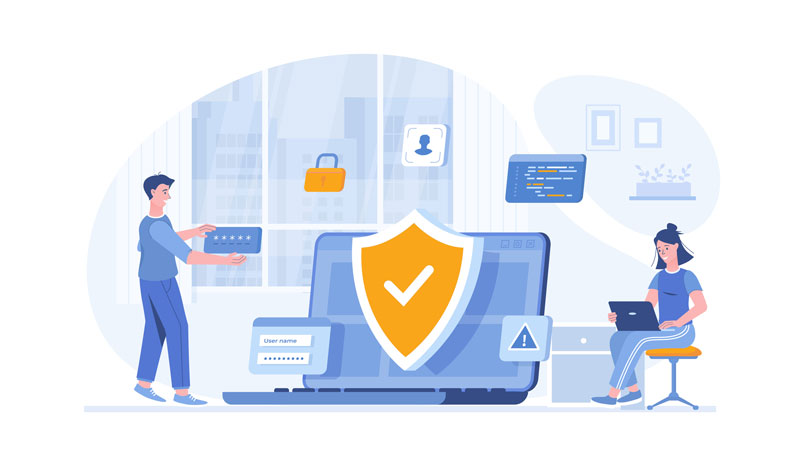
A Human Firewall isn’t just a person who knows not to click a link; it’s a culture of informed scepticism. Here is how we recommend our partners and customers fortify their own perimeters:
-
Pause before you act
Social engineers rely on high-pressure tactics. They want you to act before you think. We encourage all our users to take a security beat. If a request feels unusually urgent, especially regarding payments, credentials, or sensitive data then take 60 seconds to verify it. A two-minute pause can prevent a multi-million-dollar incident.
-
Verify via out-of-band channels
If you receive an email from “Account Support” or even an executive asking for something sensitive, don’t reply to that thread. Reach out via a different channel. Call a known phone number, send a fresh Slack/Teams message, or log in directly to our Pronto Plus portal rather than clicking a link.
-
Use MFA as your personal safety net
Multi-Factor Authentication (MFA) is one of the most effective tools we have. However, MFA Fatigue is a real tactic where attackers spam your phone with prompts until you click “Approve” just to make it stop. Rule of thumb: If you didn’t just try to log in, NEVER approve a prompt.
-
The “see something, say something” partnership
Often early detection by one alert user can save an entire network. Pronto Software cultivates a culture where reporting suspicious emails is not only encouraged it is celebrated. This also extends to our customers.
We take the management of risk very seriously and strive to ensure that our security is maintained at a high standard. This means:
- We will never ask you for your password.
- We will never ask you to bypass our established security protocols for speed.
- We will always provide verified channels for support.
Real-world scenarios: spotting the social engineer
To build a strong Human Firewall, your team needs to be able to recognise the script attackers use. Here are three common ways social engineering shows up in a typical workday:
Scenario 1: The executive urgent request (Business email compromise)
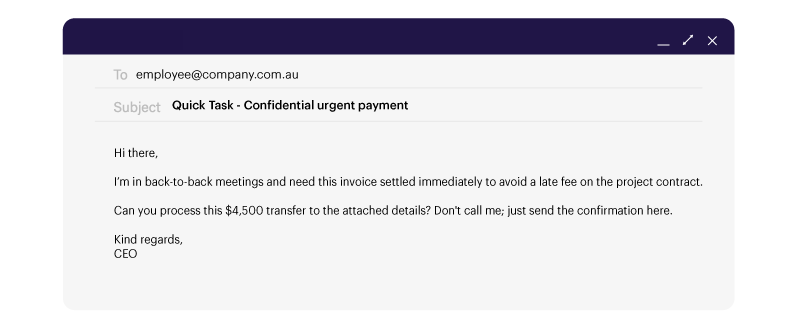
The setup: An employee in Finance receives an email that appears to be from the CEO or a high-level Director. The subject line is “Quick Task – Confidential” or “Urgent Payment.”
- The hook: “I’m in back-to-back meetings and need this invoice settled immediately to avoid a late fee on the project contract. Can you process this $4,500 transfer to the attached details? Don’t call me; just send the confirmation here.”
- The red flags: The request asks to bypass the standard portal, discourages verbal verification, and uses extreme urgency to bypass critical thinking.
- The human firewall response: The employee ignores the “do not call” instruction and sends a quick internal message to the CEO or checks the official accounting system for the referenced invoice.
Scenario 2: The IT support call (Vishing)
The setup: A staff member receives a phone call from a local-looking number. The caller sounds professional and claims to be from “The Security Team” or “The IT Help Desk.”
- The hook: “Hi, we’ve detected some unusual sync errors on your account. We need to push a security patch to your workstation. I’ve just sent a verification code to your phone, can you read that back to me so I can confirm I’m speaking to the right person?”
- The red flags: They called you out of the blue and are asking for a code that specifically says, “Do not share this with anyone.”
- The human firewall response: The employee hangs up and calls the official internal IT extension to verify if there is an active ticket for their machine.
Scenario 3: The updated vendor invoice (Supply chain attack)
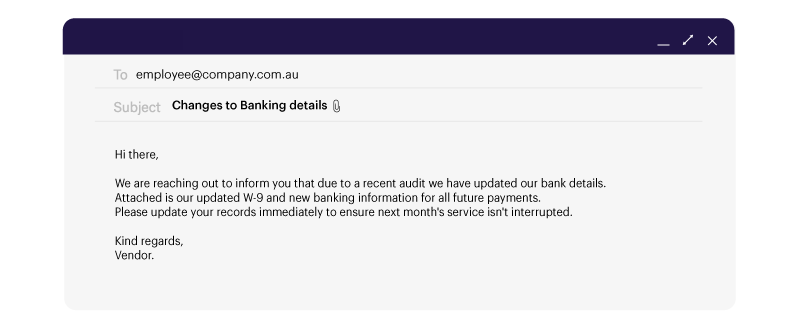
The setup: A long-term vendor sends an email (often from a hacked but legitimate account) stating they have changed their banking details due to an “audit” or “bank merger.”
- The hook: “Attached is our updated W-9 and new banking information for all future payments. Please update your records immediately to ensure next month’s service isn’t interrupted.”
- The red flags: A sudden change in financial routing instructions via email is the #1 sign of a vendor intercept.
- The human firewall response: The employee picks up the phone and calls a known contact at the vendor company using a number they have on file, not the number provided in the new email to confirm the change.
A quick checklist for your team
If a request hits more than two of these, Stop, Verify, and Report:
 Unusual channel: A request for data or money coming through an unexpected medium (e.g., a text message from a “manager”).
Emotional trigger: It makes you feel scared, pressured, or like you’re doing a special favour.
Process bypass: It asks you to ignore the way things are usually done.
Vague details: It mentions a project or contract without specific ID numbers or context you’d expect.
The bottom line
Cybersecurity is no longer a set and forget IT task. It is a shared human endeavour. When you verify a suspicious link or question an unusual request, you aren’t just protecting your account, you are strengthening the entire perimeter.
Technology is our armour, but YOU are the frontline. Working together, we create the Human Firewall.